Saturday, November 10, 2012

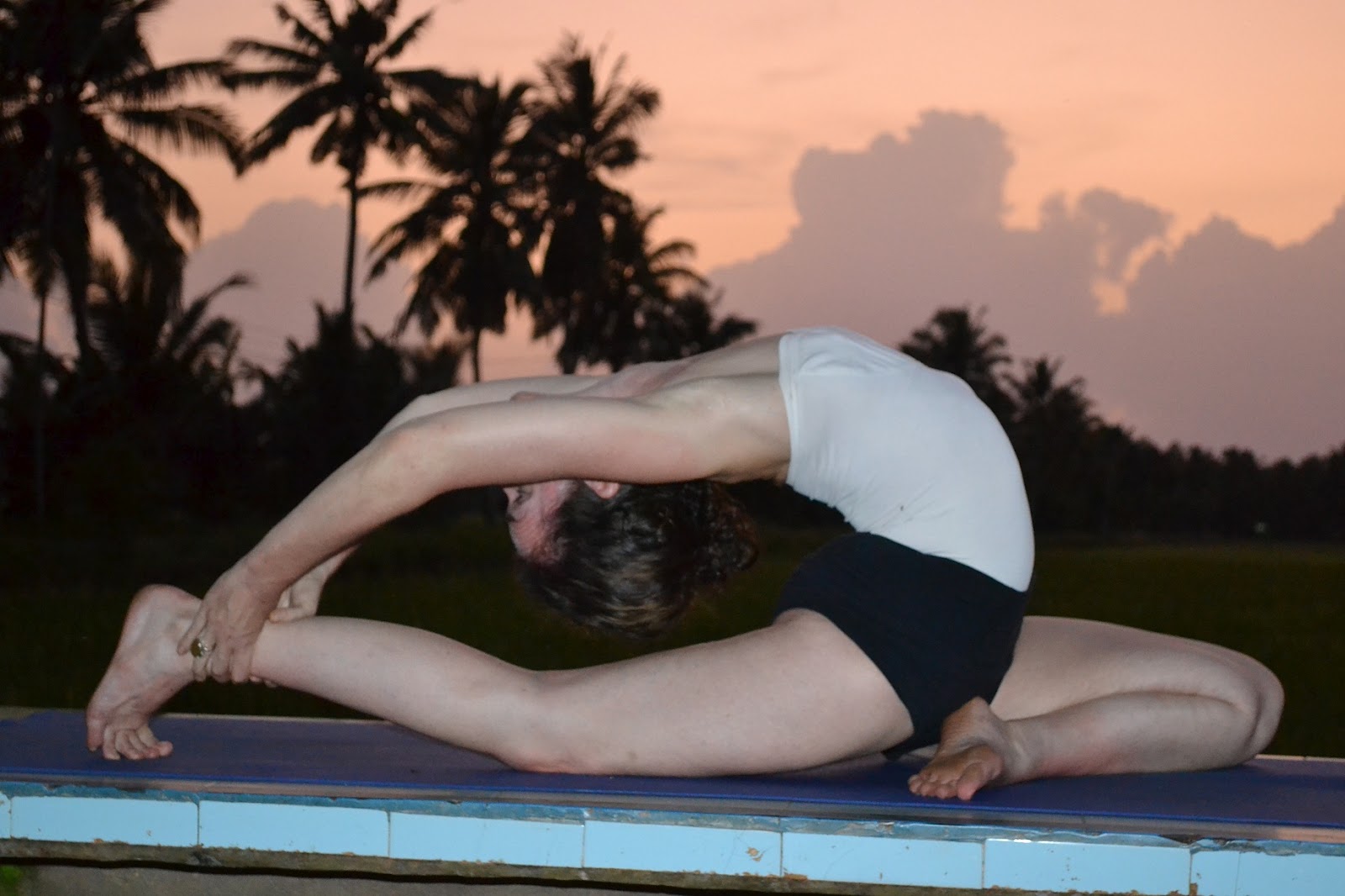
BB (backbending) Q & A with Heather Morton


Lilu Trapecista asked:  

"Sometimes I experience waist pain after backbending practice. What am I doing wrong?" Lilu also mentioned having pain wihle preparing for advanced inversions.  

There are many factors that could be attributing to this. However, it is not always about doing it wrong.

First, let's look at what kind of pain it is. There are different kinds of pain and not all pain is bad. Pattabhi Jois used to say, “little pain today and gone tomorrow”. Pain is often an indicator that the muscles and joints have been stretched physically beyond their ‘known’ limit. This is normal and a part of the process. However, determining what is actually good and bad pain can be tricky. And by the way, by no means is pain a perquisite to practice either!

Assuming this not a pain of warning (usually sharp and takes you by surprise) but an achy kinda sore feeling it is often part of the process. The best thing to take a look at is what and how you are practicing. My teacher Yogacharya (a backbending expert in Mysore) used to say pain comes when you are not fully foucsed on your breath and your gazing points. We might think we are breathing during the practice but is it natural or a forced breath? Or, just something we are mechanically doing?

Suggestion#1: Practice to observe your breath both before and after a backbend. Practice to gradually even out your breaths so that it’s calmer and steady. In backbends the breath does tend to get rapid and harsh. If you focus on exhaling you can learn to slow it down.

Pain can also arise when the practice series is not correct or right for you! When specifically practicing how to do backbends and improving your practice it is really beneficial to counter the practice with other postures. These are twists, forward bends and neutral poses.  

Suggestion #2: Practice forward bends, sitting and spinal twists. These are held for twice as long as backbends. This is the system I learned under my teacher Yogacharya. If you are doing more than 3 backbends without a counter pose you may need to incorporate a few counter postures. The vinyasa of cobra pose to down-dog and jump or sit is excellent.

It is easy to forget that backbending is not just about your back! It is all about lengthening the front of your torso, opening the chest and shoulders as well as lifting upward from the pelvis girdle. When pain arises this is a sign that some muscles have overstretched while others have under-stretched. In backbends the pressure can go into a weaker area first. Being aware of this you can make adjustments that will give you more relief.   

Suggestion #3: Practice to bend from your hips and not your waist. In standing backbends use the practice sequence of placing your hands on your waist (re: thumbs facing toward your spine). This will protect your waist and allow you to understand how to lift upward. This same movement is repeated when we bend forward (re: pulling in the low belly and extending forward).

When learning to do more advanced postures like a backbend from a headstand, handstand or scorpion, the pressure tends to go directly into the lumbar and dorsal muscles. To counter this the shoulders need to draw back, the chest to expand and the legs are active.

Suggestion #4: Practice lengthening upward with your legs and toes. Keep this lengthing as you bend backbend. When we start to bend backward while upside down the counter direction is forgotten. Keeping this 'tension' will maintain the stretch from the hips and through the torso. It is also really helpful to give more pressure into your arms. Resist the pressure from the hips while being upside down. This creates a lot of strength too! 

Try these suggestions. The counter sequencing is especially important in developing a balanced and full practice. The more the body moves sideways and forward this will enhance the backbending sequence. 

And the pain may arise as a nice opening and fuller extension. 

* Not all movements are recommended foe everyone. Consult a trained teacher or medical doctor before beginning any exercise program. The content and information is for educational purposes from Heather Morton (The Yoga Way). Any use of the material, advice and instructions is at your own risk.

Wednesday, August 22, 2012

HELLO YOGA - part 2 (Upper Back)

Learn how to open your upper back. This is a non-traditional sequence that builds flexibility in the upper back. It is a good prep for the traditional backbends such as makarasana (aka when the legs come up and off the ground) known as the crocodile.

Read it on HELLO YOGA ~ The Japan's Community of Yoga. Re: Backbending Techniques 

Monday, July 16, 2012

HELLO Backbending ~ Part 1 (Wheel)

Learn about the wheel: the key elements on what to do and what not to do. My wonderful student Alison is with me in this video and shows a great wheel. Keep in mind she only learned this pose a few short months ago and had NO prior experience. She worked through fear and tension and overcame these obstacles.

Read it on HELLO YOGA ~ The Japan's Community of Yoga. Re: Backbending Techniques 

Tuesday, June 12, 2012

The Sexy Backbend

As a yoga teacher, I get asked all kinds of questions about the practices of yoga. Sometimes they are obvious ones ranging from ``How long will it take to master a posture? `` to ``Does it ever get easy?`` There are, however, a few less obvious questions like, `` I feel very sexual during the practice. Is that okay? ``

This question was regarding the practice of the backbends of yoga. Some students have found them to elicit intense feelings, which one of my students once expressed as being "pretty orgasmic". For the more disconcerting student, however, this might be something you don't necessarily want to get messed up with in your practice. I have been practicing backbending yoga for over 10 years now and teaching it for almost the same but this was the first student who had the guts to ask if it was okay. He wanted to know if it was: 1) normal, 2) should he continue, and 3) is he the only one?

Sexual Feelings

A few years ago my teacher who is a backbending champion and one of the only teachers in Mysore, South India, to teach the proper techniques of backbending told me to beware of the power of backbends. For those who are not yet familiar with Yogacharya Venkatesha he set out a unique system in how to learn and practice them. This system has helped thousands of students from all over the world to find their way through the backbending maze. He is not only gifted as a teacher but his abilities are no less then amazing. He became nick-named as Rubber Yogi including earning the title of Yoga Samrat (Emperor of Yoga).

Now the reason he said beware and even instructed me not to practice backbends for one month during one of my visits in Mysore is because of the intensity of the postures. Combined with increased prana (energy) many of the vital chakras become stimulated (in yoga there are 7 located along the spinal cord). One chakra is the genitals and procreation (svadhisthana). It is activated in backbends because the pelvis is constantly being pressed and pushed forward as well as backward. Depending on the capacity of the student the energy can get ``stuck`` there and produce strong sexual feelings.

So, sexual arousal happens, it is normal and you are not alone.

My teacher once spoke about a student who started obsessively practising backbends. Over time their energy field was aroused beyond a ´normal´ range. It was not just sexual activities that became excessive, but they overate, oversleep and overextended themselves in many areas of their life. This caused a lot of harm to their body, mind and nervous system. It also ruined their practice.

From my own personal experience I can say backbends are so energizing it can start to take over your practice rather than having a well-balanced one. There is also an addictive quality to the feelings they create and the energy produced. I once expressed to Yogacharya how after backbending I felt cleansed, alive and revitalized.

Breathing

In backbending, the lungs get stretched and often stressed during the practice. Coupled with feelings of fear and anxiety, which many people have in the practice the breath (not just the mind) is the first thing to become unstable. Breath, body and mind are so intermingled it is difficult to sometimes understand this or stay aware of it when right in the middle of an intense backbend. The last thing that often comes to mind is working more closely with the breath as the physical tension and sensations surface.

However, the breath is key to the entire practice.

As I learned backbends more intensely under my teacher it was always by watching and staying with the breath. This might sound extremely obvious but again when entering a deep backbend it is easy to lose sight of this simple intention. Being able to keep it somewhere in the background is not only the saving grace to focusing the mind, but it  also deepens and expand the ability to exhale and inhale. In the beginning this may take several tries but learning to control the breath flow is almost more important than the position of the limbs.

I have observed in my personal practice when the breath became very heavy and the way this affected my thoughts. I have also watched how instinctively there is a tendency to want to force the breath out as if that might help deepen a backbend. Yet, it is the solid and steady practice of slow and deep breaths that allows the body to melt, the mind to slow down and unwanted thoughts to diminish. Many years ago when Ashtanga practitioners came to Yogacharya's shala it was obvious by the amount of 'forced' breaths or ujjayi breathings. Yogacharya was often running beside them saying, "no sound, no sound, no sound". It was a difficult habit to break and not the same approach as in Ashtanga-yoga.

Balance

Balance like flexibility and strength is also a question of degree. If the practice is not tempered with other postures and exercises, it can create physical, mental and emotional disturbances. This doesn't just apply to backbends but any practice. As I began studying Sivananda-yoga I had become too flexible while compromising my strengths. When I learned the primary series of Ashtanga yoga under Pattabhi Jois in Mysore my practice got leveled out with strength. In the first series there is only one backbend and a lot of forward bends in lotus.

Becoming more balanced also has a lot to do with the way you practice. Many teachers and in particular more traditional ones adhere to practicing the system of postures as there were laid out by the Master. In other words, you just don’t do whatever you feel like. There is a specific order to the postures. As well, most systems of yoga do not begin with backbends, but are near the end. Shri K. Pattabhi Jois states in the Yoga Mala that the incorrect method and sequence can weaken the body as well as the mind.

Channelling Sexual Energy

It certainly helps to not just accept being aroused sexually, but finding ways to channel it. In yoga, there are many ancient practices that deal with this since having an orgasm was considered a loss of vital fluids called ``ojas``. In the modern world it is about satisfying desire, which people misunderstand as, `´Do whatever the f*_k you want``. The teachings of yoga, however, say this is a clear way of repeating the karmic cycle of extreme highs and lows.


Feeling great, feeling shitting and doing it all over again. Or as my teacher said many times, "You only satisfy a physical need in asana and come back again to your practice to do the same thing again and again and again."


Many of the teachings have been misunderstood in terms of renouncing our physical desires, which leads to repression and denial. When the Buddha talked about letting go of attachment and desire he did not mean go home and throw everything out. An external gesture may not necessarily alter an internal state. The Buddha was talking about having the capacity and the will to take charge of directing the energy toward nobler planes. We cannot stop the mind from thinking or the feelings from feeling, but what we do in practice is become a witness or an observer to the process, the progress and the practice.


Personal Practice

The question and concern about feeling aroused by the postures sheds light on your practice: 
Is there a specific system being practiced? 
Are the breaths counted? 
Is the sequence irregular? 
Is it practiced without any continuity? 
Is it balanced with inversions, rest, twists, forward bends and proper relaxation?

Taking a look at some of these areas can help redirect one’s energies and re-balance the practice. Having sexual feelings during the practice is not wrong, but knowing what to do with them can be challenging.

Instead of being eaten up with desire or driven by our sexual fantasy we can practice to observe it. The yogic lifestyle is to learn to ride the waves and keep the energy moving.

Some of the postures that balance sexual energies are: 1) forward bends; 2) the headstand or half headstand; 3) the head to knee forward bend; 4) shoulderstand pose and, 5) meditation.

The best method can also be to consult a teacher and ask them! Everyone can learn from such an open and gutsy question including the teacher.


 Copyright The Yoga Way, Heather Morton  2012

Sunday, June 10, 2012

Push-Ups 101 of Yoga * revised version

“Even if you start doing push-ups it will not help," said Yogacharya Venkatesha to a student struggling with an arm posture.


In Mysore, India, we practice an unguided sequence, which is built from learning to practice the postures independently. As a student this is the best way to learn the physical postures. My teacher Yogacharya is well known for his ability to verbally lead students through their practice and without physical adjustments. When it comes to his instructions he hits the nail on the head and makes you feel he can read your mind. Yogacharya finishes by saying, “Strength cannot be built from the muscles alone.”

No Strength

This made me recall the time Shri K. Pattabhi Jois (Guruji) told me I had "no strength". I didn't like that. It bothered me so I started doing push-ups. I did them until I flopped on the floor. Like most people I wanted to become stronger but as a woman my feeling was intensified. I never stopped thinking about this until I found out he also said the same thing to men! Looking around the practice room in Mysore I wondered ‘how’ was I going to build strength?

Certainly many of the arm balance postures of yoga are difficult in terms of their physical tenacity. When I began studying regularly under Yogachaya he asked about my practice. When I told him I was doing push-ups he gave me a very painful (an almost dirty) look. Then he laughed. Speaking from experience push-ups do not work. I actually discovered they are good for developing stomach strength rather than arm muscle. What I also discovered is the balance, control and an unwavering ability to focus that arm postures require over physical strength. In Sanskrit this is called sthita-prajna (meaning the steadiness of thought).

Focus Your Practice

Remembering that the practices of yoga are about mind-training is one thing, but developing ways to steady the mind is another. I learned the best way to do this was by being true to one system at a time. For many years I never deviated from any of the systems I studied. There was little room for improvisations or skipping what I wanted. I started my training with Sivananda and practiced the series for years. When I learned Ashtanga yoga and later the system of AtmaVikasa it was with the same approach. However, to develop strength, as an example, I began to create a system that better served problem areas and challenges.

Troubleshooting the Practice

Taking a look at the peacock lotus pose called padma mayurasana, an intermediate pose, here is one way to break it down and work with where you are.

1. Start by opening the hips, the low back and waist as well as stretching and opening the ankles in konasana, the side angle pose, warrior and forward bends.

2. Begin with the tree pose if learning half or full lotus is unmanageable. Learn to practice the half and full lotus in all its forms (re: sitting, lying flat and upside-down).

3. Stay focused on the here and now and not how far you have to go. Forget about even lifting upward if you cannot do lotus. So maybe you cannot practice the full lotus so try it in half. That is tougher!

Make it Personal

The beauty of personalizing the practice lies not in the finished product but what gets developed along the way. An awakening for me was not when my legs folded neatly into lotus but when I understood where I was blocked internally. In a silent moment a gate was opened in being able to deepen my practice. Sharath, Guruji’s grandson, gave me an encouraging moment when he demonstrated how his knee moved out of its joint. He explained it had been 'restructured' from the practice.

As a teacher, I have consistently been big on taking this approach. That is, creating a personalized system that becomes the foundation to evolving physically, mentally and emotionally. I am not a fan of practising from start to finish as many teachers encourage. I do not see the merit in saying you can get through the primary series of Ashtanga in one hour if the entire practice has technical holes. I also know there are few artists who play a piece of music with this approach.

Taking the time to practice independently and troubleshoot areas of difficulty builds confidence, strength, independence and a greater appreciation for the practice.

So the next time my teacher asks about my practice I can safely say I dumped the push-ups.

Thursday, May 24, 2012

How Yoga Helps Us Exceed Our Limitations


Recently I received an honest query about backbending from a male practitioner and teacher of yoga. I love receiving this kind of note because it is an opportunity for more men to understand how yoga (and in particular backbending) might be good for them. It also opens a discussion on some important points to practice.

Reader Question:
I have come across your work and am very interested in backbending. I am a long time male yoga practitioner and more recently teacher. I have always been challenged by back bending and never seem to advance and fear causing myself long term injury. 
I have a very slight kyphosis which is the result of contracting Schuermanns disease in my teens. However that was only diagnosed 1 year ago. I have always had minor chronic pain in my low back but there is nothing other than bad posture. 
I have seen many advanced yoga practitioners who are accomplished with backbending but end up finding their spine has always been able to move in this way. Almost contortionistic you might say. When your spine is initially out of alignment it is difficult to know where you should be in space as you perform a backbend. You look like you never had any kind of spinal challenge. 
My presentation may look flawless but it has been years of a dedicated practice in working through all my problems. Yes, problems and wondering when things were going to get better. It may look like I possess a gift, but I have been faced with many challenges. My spine is on a slight angle; 17 degrees located in the middle of the upper back. Because of this a lower rib pops out often called a hip rib. As a kid it was always sore because it was in the way of normal activities. I had it checked by doctors who confirmed this is the way it developed in the womb. So here I am on an angle. 

Because of the above I had to learn to be more mindful of alignment and work harder at correcting it. I also had a car accident in which I fractured my scapula and broke my wrist. Due to this, my left shoulder was weaker and many problems arose as I learned inversions, arm balances and inverted backbends. What most people fail to remember is that facing limitations is not the time to give up. It is the time to make time and make the practice adjust to you. These are the little nuggets of wisdom that uncover hidden and structural problems that lie at the root of pain. Furthermore, when the spine is misaligned it is best to focus on building the supporting structure. In other words, the problem area is not addressed first but last. As an example, low back pain is not always removed by targeting the low back but in developing better upper body posture and stronger abdominal muscles. 

Many Yoga Masters say the same thing about working with limitations. They suffered through depression, disease, poverty and accidents. After learning this maybe our problems seem a bit more manageable! Yoga is to strengthen the mind. It can also and at the same time improve and correct anatomical issues. Maybe you will never learn to touch your feet to your head, but is that the point? Truly, the point is to learn to work with yourself and on all levels.... i.e., like, love, hate or dislike them.
I can’t seem to see from the information whether the practice of backbending can build a foundation for people who truly are challenged in these postures. Could you please provide some feedback for me on this? 
The practices as I learned it under my teacher offers a template for all to follow. This is the general structure:  

The sun salutations as a basic warm-up with the cobra and downward dog pose held longer. These are counter poses that support each other by stretching the spine outward and downward. Breathing is key and using the lower abdomen in order to support the low back when more intense back bends are introduced. 

The fundamental backbends include postures such as the low back wheel pose. This begins from standing and is generally practiced with the feet together. A key idea is to imagine the tail-bone tucking under and the pelvis (front) stretching. As well, the chest is widened with slow breaths. Counter postures are a grounding aspect of the practice. These are customized to suit the student, but forward bend, spinal twists and the side angle bend called konasana are the staple.

Finally the rest and relaxation stage is critical to the practice. Properly relaxation deepens the physical practice. The muscles can only be forced so far then rest is needed. 


The relaxation process is also a withdrawal from the sense organs called pratyahara. 

We can never start off perfectly or even end that way. Instead Yoga is the perfect way to help teach us to bring our limitations to the next level. And maybe many more men will develop a new interest in their backbends of yoga!  

 Copyright The Yoga Way…2012.